Do You Really Need More Bins? Here’s the Truth About Sustainable Home Organization Tips
I have a confession to make. There was a time in my life when a trip to the Container Store felt like a spiritual experience. I’d walk down those aisles, staring at the perfectly stacked acrylic bins and the matching wicker baskets, and I’d think: This is it. This is the bin that finally makes me a "put-together" person.
I would bring home a dozen clear plastic containers, spend my entire Saturday filling them up, and for about forty-eight hours, my pantry looked like a Pinterest board. But then, Monday happened. By Thursday, the "snack bin" was overflowing with half-empty granola bar boxes that didn't fit, and I found myself shoving a stray bag of flour behind the "beautiful" bins because there simply wasn't enough room.
The truth? I didn't have an organization problem. I had a "stuff" problem. And those expensive, non-recyclable plastic bins were just a very pretty way to hide it.
If you’ve ever felt the frustration of spending a fortune on organizers only to have your house return to chaos a week later, you aren’t alone. It’s time we talk about why more bins aren't always the answer and how you can create a truly sustainable, peaceful home without buying into the "container trap."
The "Bin Trap": Why More Containers Often Create More Chaos
It sounds counterintuitive, right? How can buying things designed to organize actually make your home messier?
First, bins are "clutter attractors." Have you ever noticed that an empty basket on a shelf doesn't stay empty for long? It practically begs for someone to drop a set of keys, a stray LEGO, or a piece of mail into it. Before you know it, that bin has become a "mystery box" that you’re too overwhelmed to sort through.
Secondly, containers take up physical space. In a small home, "containerizing" every single item can actually leave you with less breathing room. Single-use organizers: like those specific egg holders or soda can dispensers: lock you into one way of living. If your family decides to stop drinking soda, that plastic dispenser is now just a bulky piece of waste taking up a third of your fridge shelf.
Lastly, and perhaps most importantly, bins hide the real problem: we simply have more than we need. Buying a bin before you declutter is like putting a band-aid on a deep wound. It might look better for a second, but it’s not actually fixing anything.

Step 1: The Great Edit (Before You Buy a Single Thing!)
Sustainable organization starts with the "Edit." This isn't just about throwing things away; it’s about choosing what deserves a place in your life. When we hold onto things "just in case," we are essentially paying for them with our time, energy, and peace of mind.
If you’re feeling paralyzed by the mess, take a deep breath. You don't have to do the whole house at once. In fact, knowing how to start decluttering when overwhelmed is half the battle. Start with one drawer. Just one.
As you go, ask yourself:
- Have I used this in the last year?
- Does this item actually help me take care of my family right now?
- If I lost this, would I run out and buy it again immediately?
A great tool for the "undecided" pile is the 20/20 Rule. If you can replace an item for less than $20 and in less than 20 minutes from your home, you don’t need to store it "just in case." You can find more about how this works in our guide to the 20/20 rule for decluttering. This simple mindset shift can free up more space than any storage bin ever could!
Step 2: "Shop Your Home" for Sustainable Storage
Once you’ve done the hard work of editing your belongings (and seriously, pat yourself on the back for that!), you might find you already have everything you need to organize what’s left.
Sustainable organization is about using what we already have. It’s better for the planet, and it’s a whole lot better for your bank account. Look around your house for "hidden" organizers:
- Sturdy Shoeboxes: These are perfect for drawer dividers or for grouping similar items (like lightbulbs or batteries) on high shelves.
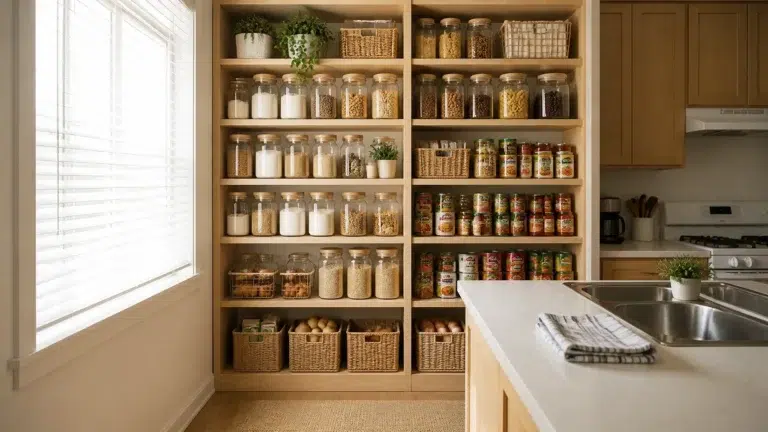
- Glass Jars: Clean out those pasta sauce or jam jars! They are beautiful, clear (so you can see what’s inside), and completely free. I use them for everything from cupcake liners to loose change.
- Shipping Boxes: With a quick trim of the top flaps, a small shipping box becomes a perfect divider for your kitchen pantry.

Using these "test containers" is a brilliant way to see if an organization system actually works for your family before you commit to buying something new. If the shoebox system works for three weeks, then maybe: and only then: you can look for a more permanent, high-quality version.
Step 3: Right-Sizing and Measuring
If you’ve decluttered, shopped your home, and still find that you need a specific container to make a space functional, it’s time to shop: but shop with a plan.
The biggest mistake we make is guessing. We go to the store, see a cute bin, and think, "That looks about right." Then we get home and realize it’s an inch too wide for the shelf.
- Measure your space: Width, depth, and height are all crucial.
- Measure your stuff: If you’re organizing a bathroom vanity, measure the tallest bottle of hairspray you own.
- Think Multi-Purpose: Avoid the "niche" organizers. Choose simple, rectangular bins that can be repurposed in the laundry room or the garage if your needs change.
Sustainable home organization isn't about being perfect; it's about being intentional. When we buy less, we have less to manage, less to clean, and more time to actually enjoy our homes.
Step 4: Maintenance Over Perfection
Organization is a journey, not a destination. No bin in the world will keep your house clean if you don't have the habits to back it up.
I’ve found that a "15-minute reset" every evening does more for my mental health than any elaborate labeling system. It’s just a quick walk through the main living areas to put things back in their "homes." When everything has a designated spot: whether that spot is a repurposed shoebox or a shelf in the closet: cleaning up becomes a reflex rather than a chore.

Don't be afraid to let your systems evolve. If you notice that your kids' toys are always ending up in a heap on the floor, maybe the bin you’re using is too hard for them to open. Change it! The goal is harmony, not a magazine-ready photo.
The Long-Term Reward: A Home That Breathes
Imagine walking through your front door after a long day at work or a chaotic afternoon of school runs. Instead of being met with a wall of visual "noise": the piles of mail, the overflowing bins, the stuff you don't even like anymore: you see space. You see the surfaces of your tables. You see only the things that serve you and your family.
You can finally breathe freely.
There is a profound sense of peace that comes from a home that isn't burdened by excess. When you stop focusing on how to store your clutter and start focusing on why you have it, the weight begins to lift. Your home becomes a sanctuary, a place of rest and connection, rather than just another item on your to-do list.

You are absolutely capable of creating this for yourself. It’s not about how much money you spend at the storage store; it’s about the small, positive steps you take every day to reclaim your space. Remember, it’s a marathon, not a sprint. Be kind to yourself as you go.
You’ve got this! One shoebox at a time, you are building a simpler, neater, and more joyful home.