Home Reset: Creating Calm for Busy Parents
Every american parent knows the feeling of walking into a living room that reflects the whirlwind of family life. With family structures shifting, the percentage of nuclear families in the United States dropped from 71% in 1970 to 47% in 2022, making home organization more challenging than ever. Tackling clutter and chaos with smart, adaptable strategies can transform your home into a peaceful space where every family member feels calmer and more connected.
Table of Contents
- Defining Home Reset For Modern Families
- Types Of Home Reset Routines Explained
- Key Steps In A Successful Home Reset
- Benefits For Stress, Mood, And Wellbeing
- Mistakes Parents Make In Home Resetting
- Maintaining Results: Daily And Weekly Strategies
Key Takeaways
| Point | Details |
|---|---|
| Home Reset Importance | A home reset addresses the emotional and physical needs of diverse family structures to create harmony in daily life. |
| Flexible Routines | Implement adaptable routines tailored to unique family dynamics to reduce stress and enhance productivity. |
| Collaborative Efforts | Engage all family members in home resetting tasks to build teamwork and teach essential organizational skills. |
| Consistency Matters | Maintain a structured approach to home reset routines to ensure long-term benefits for family well-being. |
Defining Home Reset for Modern Families
In today’s dynamic family landscape, a home reset is more than just cleaning. It’s a strategic approach to creating emotional and physical harmony in households that look dramatically different from traditional models. Family structures have shifted significantly, with nuclear families declining from 71% in 1970 to 47% in 2022, demanding more flexible home management strategies.
A home reset acknowledges that families now come in diverse configurations – blended households, multigenerational homes, single-parent families, and non-traditional living arrangements. It’s about creating systems that support each family’s unique rhythm and challenges. Modern families often navigate complex legal and social realities that redefine traditional roles and routines, making adaptable home management crucial.
The core principles of a home reset remain consistent across family types: reducing stress, creating predictable routines, and establishing spaces that nurture emotional well-being. This means developing practical organizational strategies that work for your specific household composition, whether you’re managing a bustling blended family or a compact single-parent home. The goal is transforming your living space from a source of chaos to a sanctuary of calm and connection.
Here’s how common family types experience home reset differently:
| Family Configuration | Unique Needs | Home Reset Focus |
|---|---|---|
| Blended Family | Coordinating new routines | Clear roles, flexible schedules |
| Multigenerational | Shared spaces, varied ages | Zone organization, joint tasks |
| Single-Parent | Time efficiency is key | Streamlined routines, simple systems |
| Non-Traditional | Varying responsibilities | Custom roles, open communication |
Pro tip: Start your home reset by identifying your family’s unique challenges and create a flexible system that can adapt as your household evolves.
Types of Home Reset Routines Explained
Busy parents know that maintaining household harmony requires more than just sporadic cleaning. Psychological research reveals that effective home reset routines encompass multiple types of rest, extending far beyond simple tidying. These routines are strategic approaches designed to address the physical, emotional, and mental exhaustion that comes with parenting.
Home reset routines typically fall into three primary categories: daily quick resets, weekly comprehensive resets, and monthly or seasonal deep refreshes. Daily resets might involve 15-20 minute focused sessions of clearing kitchen counters, sorting mail, and preparing for the next day. Weekly resets are more extensive, including detailed cleaning, meal planning, and family schedule coordination. Monthly or seasonal resets allow for deeper organization, like reviewing storage systems, rotating seasonal clothing, and conducting more thorough home maintenance.
Understanding that each family has unique needs, these reset routines are flexible frameworks rather than rigid prescriptions. Clever home reset strategies can support sustained calmness and productivity by creating predictable rhythms that reduce household stress. The key is finding a routine that matches your family’s energy levels, work schedules, and specific household dynamics.
Pro tip: Create a personalized reset routine checklist that can be easily adapted as your family’s needs change, focusing on consistency over perfection.
Key Steps in a Successful Home Reset
A successful home reset begins with creating a strategic plan that transforms chaos into calm. Establishing a weekly reset routine provides the foundation for maintaining a consistently organized living space. This process involves more than just cleaning – it’s about creating a systematic approach that works with your family’s unique rhythm and challenges.

The key steps in a home reset include comprehensive preparation, intentional decluttering, and establishing sustainable organizational systems. Start by gathering all necessary cleaning supplies in one portable caddy, ensuring you can move efficiently between spaces. Next, tackle high-traffic areas first – typically the kitchen, living room, and entryways. Break down each reset into manageable chunks: 15-20 minute focused sessions that prevent overwhelm and build momentum. Prioritize surfaces that collect daily clutter, like countertops, dining tables, and home office spaces.
Mindset is crucial in executing a successful home reset. Approach the process not as a chore, but as an investment in your family’s well-being and mental clarity. Involve family members by assigning age-appropriate tasks, transforming the reset from a solo mission into a collaborative effort. Create a standard checklist that can be easily followed, allowing everyone to contribute and understand their role in maintaining a calm, organized home environment.
Pro tip: Schedule your home reset during a time when energy levels are highest, and create a playlist that makes the process feel more like a fun family activity than a mundane task.
Benefits for Stress, Mood, and Wellbeing
Research demonstrates a significant correlation between organized home environments and reduced parental stress, revealing that structured home reset practices can dramatically improve overall mental well-being. When parents create predictable systems and reduce household chaos, they experience lower stress levels and increased emotional resilience. This transformation goes beyond simple cleaning – it’s about creating a psychological sanctuary that supports mental health and family harmony.
The benefits of consistent home reset routines extend far beyond surface-level tidiness. Implementing regular organizational strategies can help parents manage emotional regulation, reduce anxiety, and create a sense of control in their daily lives. By breaking down overwhelming tasks into manageable steps, parents can experience a significant reduction in mental load. These practices help transform the home from a source of stress into a collaborative, supportive environment that nurtures both parental and child emotional well-being.
Mindfulness is a critical component of these stress-reduction strategies. Self-care practices embedded in home reset routines support emotional presence and mental clarity, allowing parents to be more engaged and responsive to their family’s needs. The psychological benefits include improved mood, decreased feelings of overwhelm, and increased capacity to handle daily challenges. By treating home reset as a form of self-care rather than a mundane chore, parents can shift their perspective and transform their relationship with household management.
Pro tip: Incorporate short mindfulness moments during your home reset, like taking three deep breaths between tasks, to amplify the stress-reduction benefits and make the process more enjoyable.
Mistakes Parents Make in Home Resetting
Common mistakes in home resetting often stem from unrealistic expectations and rigid approaches, creating unnecessary stress for families. Parents frequently fall into the trap of pursuing perfection instead of progress, setting themselves up for frustration and potential burnout. These unrealistic standards can transform what should be a collaborative, supportive process into a source of tension and disappointment.
One significant error is over-functioning by completing all household tasks independently, which prevents children from developing essential organizational skills. Parents often struggle with delegation and allowing children to experience manageable failures, ultimately hindering family cooperation and individual growth. Instead of doing everything themselves, parents should view home resetting as an opportunity to teach responsibility, create age-appropriate tasks, and build teamwork within the family unit.
Inconsistency represents another critical mistake in home reset strategies. Parents frequently abandon routines after initial challenges, fail to maintain established systems, or create overly complex procedures that are impossible to sustain. Successful home resets require adaptable, flexible approaches that can evolve with changing family dynamics. This means being willing to adjust strategies, communicate openly about expectations, and recognize that perfect execution is less important than consistent, imperfect progress.
Pro tip: Create a family reset routine with built-in flexibility, involving all family members in developing and adjusting the system to ensure long-term commitment and success.
Maintaining Results: Daily and Weekly Strategies
Developing a structured cleaning schedule is essential for working parents seeking to maintain a calm home environment. Successful home maintenance requires a strategic approach that breaks down overwhelming tasks into manageable daily and weekly routines. The key is creating a system that integrates seamlessly with your family’s unique rhythm, transforming home organization from a daunting challenge into a sustainable lifestyle.
Daily strategies focus on quick, targeted interventions that prevent clutter from accumulating. These include morning reset habits like making beds, clearing kitchen counters after meals, and doing a 10-minute evening tidy-up. Implement a family-wide system where each member is responsible for returning items to their designated spaces immediately after use. High-traffic areas like entryways, kitchen, and living rooms should receive special attention, with short 5-10 minute cleanup sessions becoming a natural part of your daily rhythm.
Weekly strategies provide a more comprehensive approach to home maintenance. Assign specific cleaning tasks to different days of the week to distribute the workload and prevent weekend overwhelm. For instance, Monday might be laundry day, Tuesday for bathroom cleaning, Wednesday for vacuuming, and so on. This approach allows for consistent home maintenance without creating a massive cleaning marathon. Involve family members by creating age-appropriate checklists and rotating responsibilities, which not only helps distribute the work but also teaches children valuable organizational skills.
Here is a quick comparison of daily vs. weekly home reset strategies:
| Aspect | Daily Reset | Weekly Reset |
|---|---|---|
| Time Needed | 10-20 minutes | 1-2 hours |
| Goal | Prevent clutter | Deep organization |
| Tasks | Tidy surfaces, quick cleanups | Laundry, detailed cleaning, planning |
| Involvement | All family ages | Usually older children/adults |
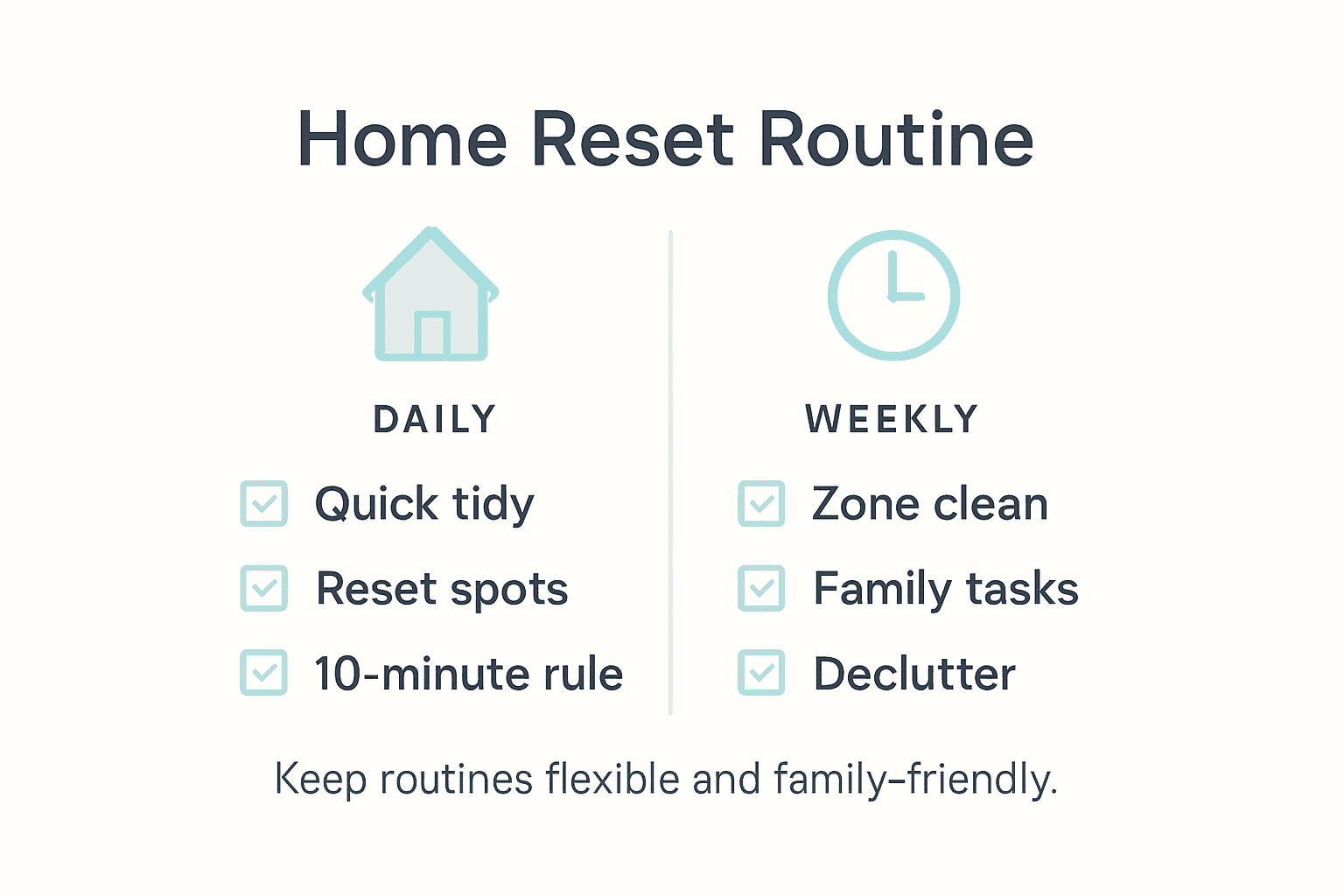
Pro tip: Create a visual family cleaning calendar with color-coded tasks and reward systems to make home maintenance feel like a collaborative game rather than a chore.
Reclaim Calm and Control with a Simple Home Reset
Busy parents face the tough challenge of transforming chaotic living spaces into peaceful sanctuaries that support emotional wellbeing and reduce stress. This article highlights the power of tailored home reset routines to create calm amidst the noise by developing flexible, manageable systems for your unique family dynamics. Whether you are coordinating a blended family’s schedule or seeking streamlined routines for a single-parent household, mastering these reset strategies is key to lasting harmony.
Explore practical cleaning tips and organizational advice at Cleaning Archives | Simple Neat Home to effectively reduce household chaos. Discover how to implement daily and weekly resets that fit your busy lifestyle at Simple Neat Home. Taking action today means turning your home into a supportive space that nurtures your entire family’s wellbeing. Start your transformation now and reclaim peace in your home!
Frequently Asked Questions
What is a home reset, and why is it important for busy parents?
A home reset is a strategic approach to create emotional and physical harmony in the household, especially important for busy parents managing diverse family dynamics. It helps reduce stress, establish predictable routines, and transform chaotic living spaces into calming environments.
How can busy parents create effective daily and weekly reset routines?
Busy parents can create effective reset routines by breaking tasks into manageable chunks. Daily resets may involve 10-20 minute quick cleanups, while weekly resets should focus on deeper organization tasks spread throughout the week to prevent overwhelm.
What are common mistakes parents make during home resetting?
Common mistakes include setting unrealistic expectations for perfection, over-functioning by not delegating tasks to family members, and inconsistency in maintaining routines. Recognizing these pitfalls can help parents create more effective resetting strategies.
How does a home reset benefit mental well-being and family harmony?
A home reset enhances mental well-being by reducing parental stress and creating a supportive environment. Regular organizational practices improve emotional regulation, leading to a calmer and more responsive family life.
Recommended
- What is Sunday Reset? Understanding the Weekly Refresh | Simple Neat Home
- Nightly Reset: The Secret to a Tidy, Decluttered Home | Simple Neat Home
- Sunday Reset Routine | Simple Neat Home
- How to Maintain an Organised Home With a Family
- 7 Modern Family Room Ideas for Stylish Comfort


