Decluttering Tips for Families: 5 Proven Ways to Organize
Families across the U.S. and U.K. face a persistent challenge: clutter that creeps into every corner of the home, creating stress and chaos in what should be a peaceful sanctuary. Research shows over 90% of UK households live with clutter, with only 7% maintaining truly clutter-free spaces. This article delivers five practical, family-friendly decluttering strategies backed by expert insights and real data. You’ll discover simple criteria for deciding what stays or goes, step-by-step methods to involve every family member, and sustainable systems to keep your home organized long after the initial cleanup. Let’s transform your living space from chaotic to calm.
Table of Contents
- Why Family-Friendly Decluttering Is Essential In 2026
- Simple Yet Effective Decluttering Criteria For Families
- Top 5 Decluttering Tips For Families: Step-By-Step List
- Maintaining A Clutter-Free Family Home: Strategies That Stick
- Reclaim Your Family’s Calm With Simple Neat Home
- Frequently Asked Questions About Decluttering Tips For Families
Key takeaways
| Point | Details |
|---|---|
| Clutter impacts most homes | Over 90% of households struggle with clutter, directly affecting stress levels and perceived home beauty. |
| Small steps work best | Short 15-20 minute sessions with clear criteria prevent overwhelm and build sustainable habits. |
| Family involvement is essential | Engaging kids through treasure hunts and rewards makes decluttering fun while teaching responsibility. |
| Maintenance prevents relapse | Without ongoing systems, 80% of clutter returns within six months of initial cleanup efforts. |
| High-impact areas first | Starting with living rooms and kitchens delivers immediate visible results that motivate continued progress. |
Why family-friendly decluttering is essential in 2026
Clutter doesn’t just make your home look messy. It creates a tangible burden on family well-being that researchers have measured and documented. When you walk into a room filled with scattered toys, piled papers, and miscellaneous items, your brain processes visual chaos that triggers stress responses. Studies confirm clutter amps up cortisol stress hormone, especially in families who feel emotionally paralyzed by the sorting decisions ahead.
The connection between physical space and mental health runs deeper than you might expect. Research demonstrates home clutter correlates moderately with reduced well-being, mediated by how beautiful and comfortable you perceive your home to be. When clutter diminishes your home’s aesthetic appeal, it simultaneously diminishes your satisfaction and peace of mind. This relationship affects every family member, from stressed parents to children who struggle to focus on homework amid visual distractions.
Families face unique decluttering challenges compared to single adults or couples:
- Multiple people generate multiple streams of belongings, from school papers to sports equipment
- Children accumulate toys, art projects, and clothing at rapid rates as they grow
- Shared spaces become dumping grounds when family members lack personal organization systems
- Emotional attachments to children’s items make sorting decisions more complex
Understanding the role of home organization in family dynamics helps you recognize why tackling clutter matters beyond simple aesthetics. A decluttered home reduces daily friction, speeds up morning routines, and creates physical space for family activities. When you remove excess belongings, you’re not just cleaning. You’re building an environment where your family can thrive with less stress and more focus on what truly matters.
“The objects in our homes have a profound impact on our mental state. Clutter creates cognitive overload that makes it harder to focus and process information.”
This cognitive burden affects children’s ability to concentrate on schoolwork and parents’ capacity to manage household responsibilities efficiently. Recognizing these impacts provides the motivation needed to commit to sustainable decluttering practices that benefit everyone under your roof.
Simple yet effective decluttering criteria for families
The biggest obstacle families face isn’t physical clutter itself but decision paralysis about what to keep or discard. You need clear, simple criteria that cut through emotional attachment and help you make confident choices quickly. Expert organizers recommend starting small with one drawer or 20-minute sessions, batching similar items together, and eliminating the maybe pile entirely.
Here’s your decision framework for evaluating any item:
- Touch it once and decide immediately: keep, donate, or discard
- Ask if you’d pack this item if moving tomorrow (pretend you’re relocating)
- Set physical space limits per category (one bin for art supplies, two shelves for books)
- Apply the one-year rule: if unused in 12 months, it goes
- Check for duplicates and keep only the best version
The declutter 100 items in 10 days challenge demonstrates how quickly small decisions accumulate into significant progress. By removing 10 items daily, you build momentum without overwhelming your schedule or emotional capacity. This approach works especially well for families because it fits into existing routines rather than requiring dedicated weekend marathons.
Pro Tip: Set a timer for 15 minutes each evening and complete a quick reset where every family member returns five items to their proper homes. This daily micro-habit prevents new clutter from accumulating while reinforcing organization as a family value.
Children benefit from age-appropriate decluttering tasks that teach decision-making skills. Young kids can sort toys into keep and donate piles during treasure hunts where they search for items they’ve outgrown. Older children can evaluate their belongings using the same criteria adults apply, developing critical thinking about consumption and ownership.
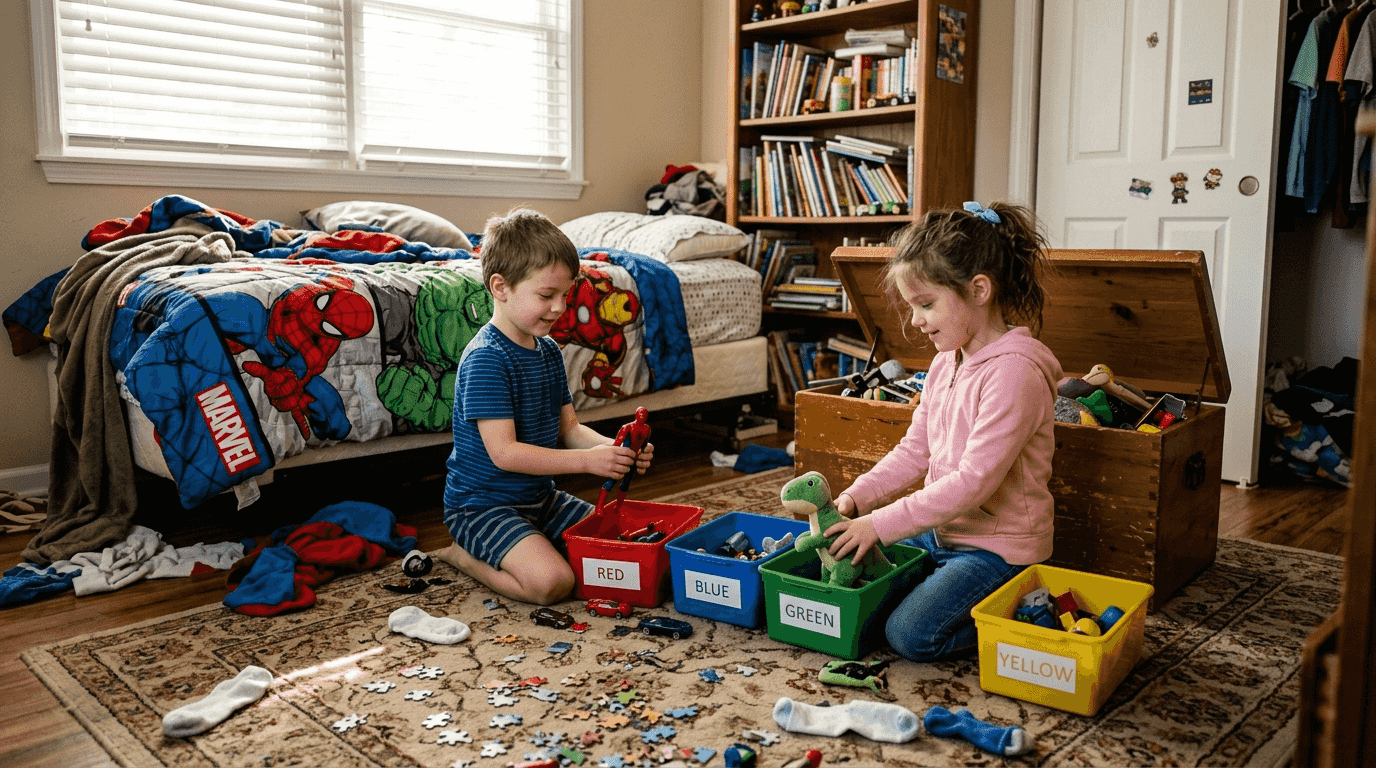
The key to sustainable decluttering lies in making decisions in batches rather than one item at a time. When you gather all similar items (every stuffed animal, all the craft supplies, every kitchen gadget), you see the full scope of what you own in that category. This visual inventory naturally reveals duplicates, forgotten items, and excess that’s easy to release. You’ll find yourself asking, “Do we really need seven spatulas?” when they’re all laid out on the counter together.
Implementing 10-minute decluttering tasks throughout your week maintains progress without requiring massive time commitments. These brief sessions fit into transition moments: before dinner, after school pickup, or while waiting for laundry to finish. The cumulative effect of consistent small actions outperforms sporadic intensive cleanouts every time.
Top 5 decluttering tips for families: step-by-step list
These five strategies combine expert recommendations with proven family engagement techniques that transform decluttering from dreaded chore into manageable routine.
-
Create family declutter days with rewards. Schedule monthly sessions where everyone participates together. Play upbeat music, set a timer for focused work periods, and celebrate completion with a family treat or movie night. This approach builds positive associations with organizing while distributing the workload fairly. Involving kids with mini treasure hunts and family declutter days makes the process engaging rather than punitive.
-
Start with high-impact visible areas. Focus initial efforts on spaces everyone uses daily: living room and kitchen. These rooms deliver immediate visible results that motivate continued progress. When you can actually see your coffee table surface or find utensils without digging, the benefits become tangible quickly. Use the living room decluttering checklist to systematically address every surface and storage area in this central family space.
-
Use treasure hunts to engage children. Turn decluttering into a game where kids search for specific categories: toys they’ve outgrown, books they’ve finished, clothes that no longer fit. Offer small rewards for participation and let them choose which charity receives their donations. This involvement teaches generosity and responsibility while reducing resistance to letting go of belongings.
-
Schedule annual deep cleans for renewal. Beyond daily maintenance, commit to thorough seasonal decluttering that refreshes your entire home. Research shows 78% of households feel lighter and more in control after annual spring cleaning. These deeper sessions address storage areas, closets, and accumulated papers that daily resets don’t reach. Follow a comprehensive step by step decluttering guide to ensure you cover every room systematically.
-
Implement maintenance systems immediately. The most critical step happens after initial decluttering: establishing habits that prevent relapse. Statistics reveal 80% of clutter returns within 6 months without maintenance systems. Apply the one-in-one-out rule where new items require removing something old. Create designated drop zones with labeled baskets for incoming mail, school papers, and daily essentials.
Pro Tip: Take before and after photos of each decluttered space. When motivation wanes, reviewing these visual transformations reminds your family why the effort matters and how far you’ve progressed.
The table below compares time investment versus impact for different decluttering approaches:
| Approach | Time Required | Immediate Impact | Sustainability |
|---|---|---|---|
| Daily 15-min resets | 15 min/day | Low per session | High long-term |
| Weekend deep clean | 4-6 hours | High visibility | Medium without follow-up |
| Monthly family days | 2-3 hours | Medium-high | High with routine |
| Annual spring clean | 8-12 hours | Very high | Low without maintenance |
Balancing quick daily habits with periodic deeper sessions creates the most effective long-term strategy. You maintain baseline organization through brief consistent efforts while seasonal cleanouts address accumulation that inevitably occurs despite best intentions.
Maintaining a clutter-free family home: strategies that stick
Achieving an organized home feels amazing. Keeping it that way requires intentional systems that work with your family’s actual habits, not idealized versions of how you think you should behave. The sobering reality that 80% of clutter returns within 6 months underscores why maintenance systems matter as much as initial decluttering.
Successful maintenance combines three elements: physical systems, family habits, and regular resets. Physical systems include designated homes for every category of belonging, labeled storage containers, and strategic placement of drop zones near entry points. When items have obvious homes, family members can return them without thinking or asking where things go.
Compare these popular maintenance approaches:
| System | How It Works | Best For | Potential Challenge |
|---|---|---|---|
| One-in-one-out | New purchase requires discarding one item | Controlling toy and clothing accumulation | Requires discipline at point of purchase |
| Seasonal resets | Quarterly review and purge of each room | Catching gradual buildup | Needs calendar commitment |
| Landing stations | Designated baskets/tables for daily items | Managing papers, keys, bags | Can become clutter magnets without daily sorting |
| 15-minute daily tidy | Quick family reset before bed | Preventing overnight accumulation | Requires consistent participation |
The most effective strategy combines multiple approaches rather than relying on a single method. Implement one-in-one-out for toys and clothing, maintain landing stations with daily sorting, and schedule seasonal deep reviews. This layered approach catches clutter at different stages before it becomes overwhelming.
Family involvement remains crucial for sustainable maintenance. When children participate in donation runs and understand where their outgrown items help others, they develop healthier relationships with possessions. Assign age-appropriate responsibilities: young kids can match socks and sort toys, while teens can manage their own closets and desk areas using family-wide organizational principles.
Pro Tip: Place a donation box in each bedroom closet. When family members notice outgrown clothes or unused items, they can immediately place them in the box rather than returning them to shelves. Once boxes fill, schedule a family donation trip together.
Reducing decision fatigue helps maintain momentum. Establish simple rules that eliminate constant negotiation: school papers get reviewed weekly then recycled, broken toys go straight to trash, and clothes that don’t fit leave the house immediately. These automatic decisions prevent the emotional paralysis that leads to maybe piles and delayed action.
The how to maintain an organized home with a family guide offers additional strategies for building sustainable habits that stick. Key insights include creating visual systems children can follow independently, establishing consistent routines around high-clutter times like after school, and celebrating small wins to maintain motivation.
Consistency in small daily actions outperforms sporadic intensive efforts. A 15-minute family reset each evening prevents the weekend avalanche of accumulated mess. When everyone participates briefly but regularly, the burden never falls entirely on one person, and clutter never reaches crisis levels. Review decluttering checklist tips to refine your maintenance approach and identify any gaps in your current system.
Reclaim your family’s calm with Simple Neat Home
Transforming your home from cluttered to calm creates space for what truly matters: quality time with family, reduced daily stress, and a peaceful environment where everyone thrives. The decluttering strategies you’ve learned here provide the foundation, but sustaining an organized home requires ongoing support and fresh ideas. At Simple Neat Home, we’re dedicated to helping families like yours maintain the calm you’ve worked hard to create. Explore our comprehensive guides on home organization and discover practical solutions for every room in your house. From kitchen organization systems to seasonal decluttering schedules, you’ll find actionable tips that fit your family’s real life. Our step-by-step approach breaks down overwhelming projects into manageable tasks that deliver visible results quickly. Join our community of families reclaiming calm from chaos, one organized space at a time.
Frequently asked questions about decluttering tips for families
How do I get my kids involved in decluttering?
Turn decluttering into engaging activities like treasure hunts where children search for outgrown toys or clothes. Offer small rewards for participation and let them choose which charity receives donations, teaching generosity alongside organization skills.
What if family members resist decluttering efforts?
Start with shared spaces everyone uses and focus on benefits like easier cleaning and more room for activities. Set small achievable goals together rather than demanding immediate perfection, building momentum through visible quick wins.
How often should families declutter their homes?
Combine daily 15-minute resets with monthly focused sessions on specific rooms and annual deep cleans for storage areas. This layered approach prevents overwhelming buildup while maintaining baseline organization year-round.
Is donating better than throwing away usable items?
Yes, donation extends item lifecycles, reduces landfill waste, and teaches children about helping others. Research local charities accepting specific items and involve kids in delivery trips to reinforce the positive impact.
What maintenance system works best for busy families?
The one-in-one-out rule combined with designated landing stations offers the easiest sustainable approach. These systems require minimal daily effort while preventing the gradual accumulation that leads to future decluttering marathons.
Recommended
- 7 Essential Tips for Your Decluttering Checklist 2025 | Simple Neat Home
- Beyond Books: 5 Unexpected Things to Declutter for Mental Clarity | Simple Neat Home
- 7 Essential Home Organization Tips to Simplify Your Space | Simple Neat Home
- 7 Decluttering Strategies To Implement This Year For A Clutter-Free Home | Simple Neat Home


